Engine parts
The spark plug, the carburettor, the camshaft, the flywheel and the rest, one at a time.
Spark plugs and ignition
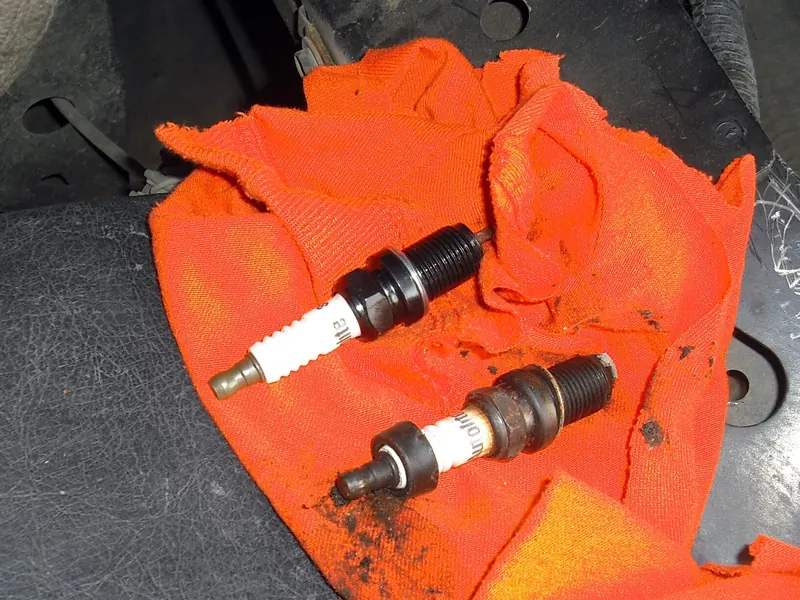
A spark plug fits into the cylinder head and has two electrodes with a small air gap; current jumps the gap as a spark that lights the air-fuel mixture. Encyclopaedia Britannica: Spark plug A spark plug’s insulator must stand up to high temperatures and up to several thousand volts. Encyclopaedia Britannica: Spark plug
A car’s ignition system turns the battery’s low voltage, usually 12 volts, into some 40,000 volts for the spark plugs. Encyclopaedia Britannica: Ignition system The distributor sends each burst of high-voltage current to the right spark plug in the firing order. Encyclopaedia Britannica: Ignition system
Many modern engines have no distributor: a coil sits on top of each spark plug (coil-on-plug). Encyclopaedia Britannica: Ignition system
Getting fuel in
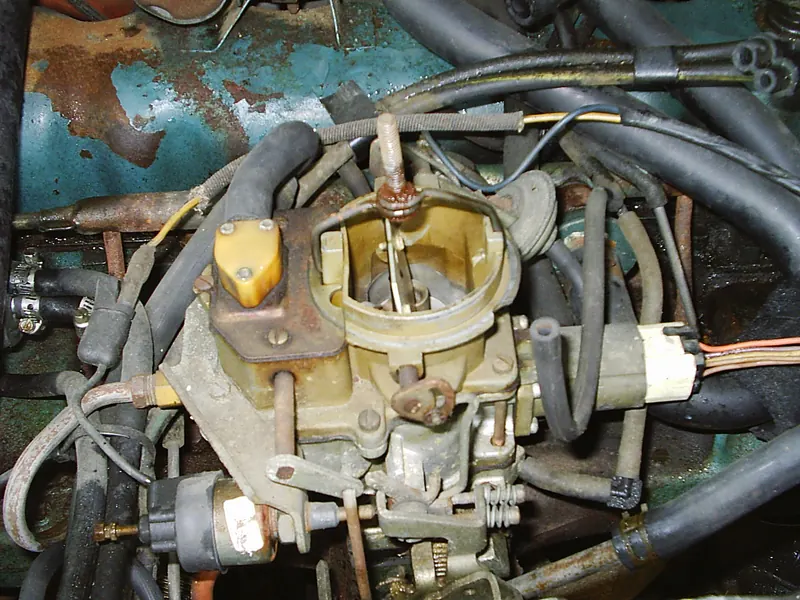
A carburettor supplies a spark-ignition engine with its mix of fuel and air; its choke gives a fuel-rich mixture to start a cold engine. Encyclopaedia Britannica: Carburettor In a carburettor, a narrow venturi in the air flow lowers the pressure and draws fuel from the main jet into the air stream. Encyclopaedia Britannica: Carburettor
From the 1970s, computer-controlled fuel injection replaced the carburettor in almost all petrol engines except two-strokes and small engines like those in lawn mowers. Encyclopaedia Britannica: Carburettor
Fuel injection uses a pump to put fuel into the cylinders, instead of relying on the suction of the moving pistons. Encyclopaedia Britannica: Fuel injection Fuel injection shares fuel more evenly between the cylinders than a carburettor, so more power can be made and fewer unwanted emissions. Encyclopaedia Britannica: Fuel injection
In a modern petrol car an electronic control module controls the fuel mixture, the ignition timing and the emissions system. US Department of Energy, Alternative Fuels Data Center: How do gasoline cars work?
More air, more power
A supercharger is an air compressor that raises the pressure of the air going into the engine, so more fuel can be burnt each cycle and the engine makes more power. Encyclopaedia Britannica: Supercharger A turbocharger is a blower driven by a small turbine that is spun by the engine’s own exhaust gases. Encyclopaedia Britannica: Supercharger
In aircraft piston engines, supercharging makes up for the thinner air at high altitude. Encyclopaedia Britannica: Supercharger
Valves and the camshaft
The camshaft turns at a fixed ratio to the crankshaft, and its cams open each valve at exactly the right moment, with pauses while the valves stay shut. Encyclopaedia Britannica: Cam If a cam’s follower is not held in a groove, a spring keeps it pressed against the cam. Encyclopaedia Britannica: Cam
The Wright brothers’ 1903 engine opened its intake valve “automatically” by suction; modern engines use cams and rocker arms for better timing. NASA Glenn Research Center: Engine mechanical operation
The flywheel
A flywheel is a heavy wheel on a turning shaft that smooths out the delivery of power and stores energy. Encyclopaedia Britannica: Flywheel In a car engine the flywheel smooths out the pulses from the cylinders and gives energy for the pistons’ compression strokes. Encyclopaedia Britannica: Flywheel
Double a flywheel’s speed and its stored energy goes up four times. Encyclopaedia Britannica: Flywheel
In a car, the clutch is built into the engine’s flywheel. Encyclopaedia Britannica: Gasoline engine
Cleaning the exhaust
A catalytic converter passes the exhaust through a honeycomb or pellets coated with a catalyst, turning hydrocarbons and carbon monoxide into water vapour and carbon dioxide. Encyclopaedia Britannica: Catalytic converter A catalytic converter also turns nitrogen oxides back into nitrogen and oxygen. Encyclopaedia Britannica: Catalytic converter
Next: gears and power →