The four-stroke cycle
Intake, compression, power, exhaust: the cycle inside almost every car engine.
Burning fuel inside the engine
In an internal-combustion engine the fuel and air burn inside the engine itself, and the hot gases push on a moving surface such as the face of a piston. Encyclopaedia Britannica: Internal-combustion engine Every internal-combustion engine burns its air-fuel mixture, takes work from the expanding hot gases, then lets the burnt gases out through the exhaust. Encyclopaedia Britannica: Internal-combustion engine
Internal-combustion engines are the most widely used power-generating devices in existence: petrol and diesel engines, gas turbines and rockets are all examples. Encyclopaedia Britannica: Internal-combustion engine
Internal-combustion engines come in two groups: continuous-combustion engines, such as a jet engine with its steady flame, and intermittent-combustion (reciprocating) engines, such as petrol and diesel piston engines. Encyclopaedia Britannica: Internal-combustion engine
A steam engine is an external-combustion engine: its working fluid does not burn, and it gains energy only by heat passing into it through a heat exchanger. Encyclopaedia Britannica: Internal-combustion engine
The four strokes
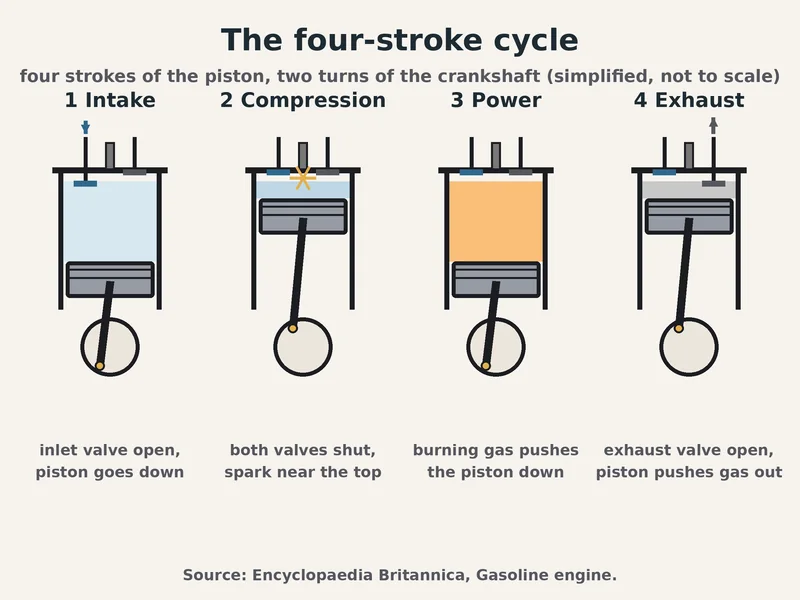
- Intake stroke: with the inlet valve open, the piston moves down and draws a mixture of petrol vapour and air into the cylinder. Encyclopaedia Britannica: Gasoline engine
- Compression stroke: with both valves closed, the piston moves up and squeezes the mixture; near the top an electric spark sets it alight. Encyclopaedia Britannica: Gasoline engine
- Power stroke: with both valves still closed, the expanding burnt gas presses the piston down. Encyclopaedia Britannica: Gasoline engine
- Exhaust stroke: the rising piston pushes the burnt gases out through the open exhaust valve, and the cycle starts again. Encyclopaedia Britannica: Gasoline engine
Each four-stroke cycle takes four strokes of the piston (intake, compression, power and exhaust) and two turns of the crankshaft. Encyclopaedia Britannica: Gasoline engine
A four-stroke engine makes only half as many power strokes as a two-stroke, but it clears out the exhaust and refills the cylinders better. Encyclopaedia Britannica: Gasoline engine
The four-stroke cycle, the most important way of getting power from burning fuel so far, was first developed in the late 19th century. Encyclopaedia Britannica: Gasoline engine The most common internal-combustion engine is the four-stroke, petrol-powered, spark-ignition engine, thanks to its performance in road transport. Encyclopaedia Britannica: Internal-combustion engine
See it move: try Inside the Engine.
From pushing to turning
In a piston-and-cylinder engine, the pressure of the burning fuel pushes the piston along the cylinder in a back-and-forth (reciprocating) motion. Encyclopaedia Britannica: Gasoline engine
The force on the piston passes down the connecting rod to the crankshaft, which turns the piston’s straight-line motion into turning motion. NASA Glenn Research Center: Engine mechanical operation
To raise the pressure in the compression stroke, the piston has to do work on the mixture, just as you do work to pump up a bicycle tyre. NASA Glenn Research Center: Engine mechanical operation
Power is the work done in each cycle multiplied by the number of cycles each second. NASA Glenn Research Center: Internal combustion engine (Otto cycle) A real engine always produces less work than the ideal cycle, which assumes no friction and no heat lost during compression and power. NASA Glenn Research Center: Internal combustion engine (Otto cycle)
An engine that flew
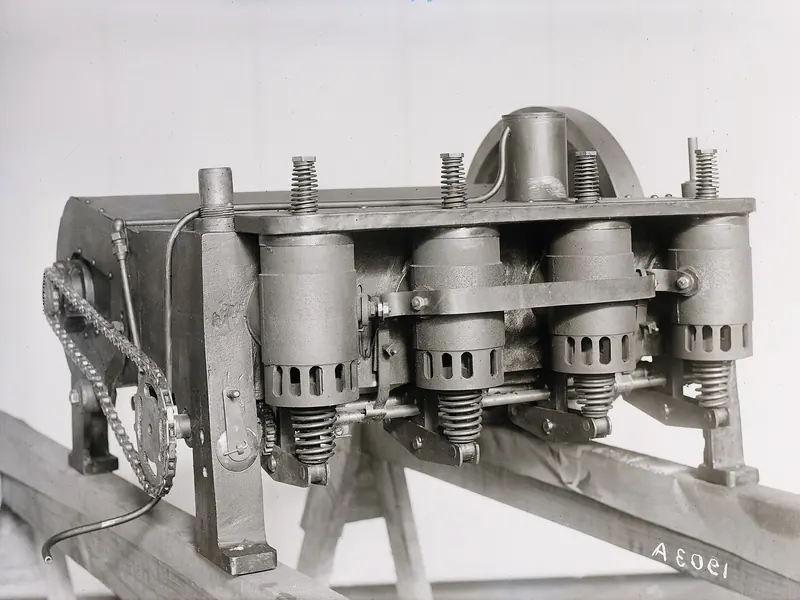
The Wright brothers’ 1903 Flyer was powered by a four-stroke engine with four cylinders, each piston joined to one crankshaft. NASA Glenn Research Center: Engine mechanical operation The Wright brothers based their engine on early car engines that used the Otto cycle, developed by Nikolaus Otto in 1876. NASA Glenn Research Center: Internal combustion engine (Otto cycle)
Where the energy goes
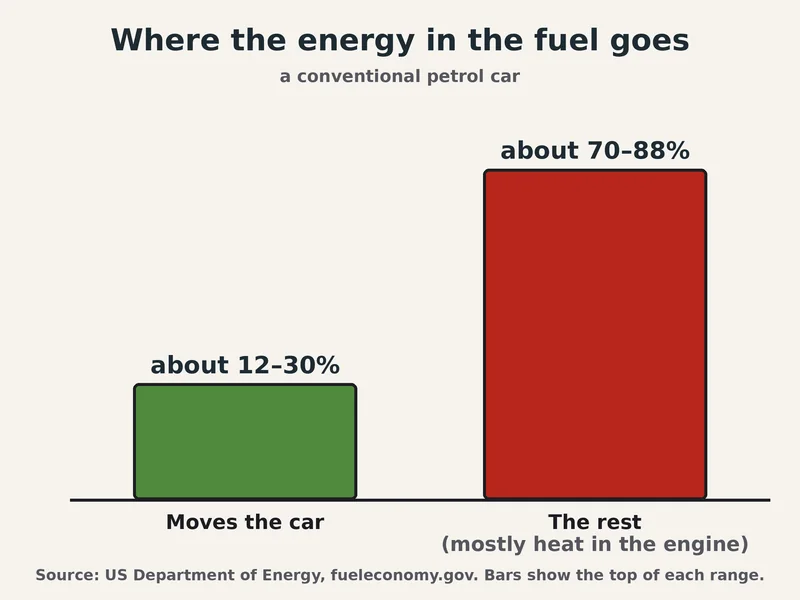
Only about 12% to 30% of the energy in the fuel you put in a conventional car is used to move it down the road. US Department of Energy and EPA, fueleconomy.gov: Where the energy goes (petrol vehicles)
In a petrol car, most of the fuel’s energy is lost in the engine, mainly as heat. US Department of Energy and EPA, fueleconomy.gov: Where the energy goes (petrol vehicles)
Car engines
Most cars have used four-stroke petrol piston engines, while diesel engines are widely used for lorries and buses. Encyclopaedia Britannica: Automobile The petrol engine was first chosen for cars because it ran well over a wide range of speeds, gave reasonable power for its weight, could be mass-produced cheaply and used a readily available fuel. Encyclopaedia Britannica: Automobile
In the United States, bigger cars moved from long straight engines to compact V6 and V8 layouts, while smaller cars used four-cylinder engines. Encyclopaedia Britannica: Automobile European car engines ranged from 1 to 12 cylinders; most had four cylinders in a straight line. Encyclopaedia Britannica: Automobile
To save fuel, some engines have as many as five valves per cylinder. Encyclopaedia Britannica: Automobile
Engine oil does more than reduce friction: it also cools, cushions noise and seals the gap between the piston rings and the cylinder walls. Encyclopaedia Britannica: Automobile A gear-type pump sends filtered oil under pressure through drilled passages to the engine’s bearings. Encyclopaedia Britannica: Automobile
Next: petrol and diesel →