Two-strokes, rotaries, hybrids and electric cars
Not every engine has four strokes, and not every car has an engine.
The two-stroke
In the original two-stroke cycle of 1878, the engine does the compression and power strokes without separate intake and exhaust strokes, so one turn of the crankshaft completes the cycle. Encyclopaedia Britannica: Gasoline engine A simpler two-stroke that uses the crankcase to pump in the fresh mixture was introduced in 1891. Encyclopaedia Britannica: Gasoline engine
In loop scavenging, the simplest way to swap exhaust for fresh mixture, the top of the piston steers the new charge up one side of the cylinder and down the other. Encyclopaedia Britannica: Gasoline engine
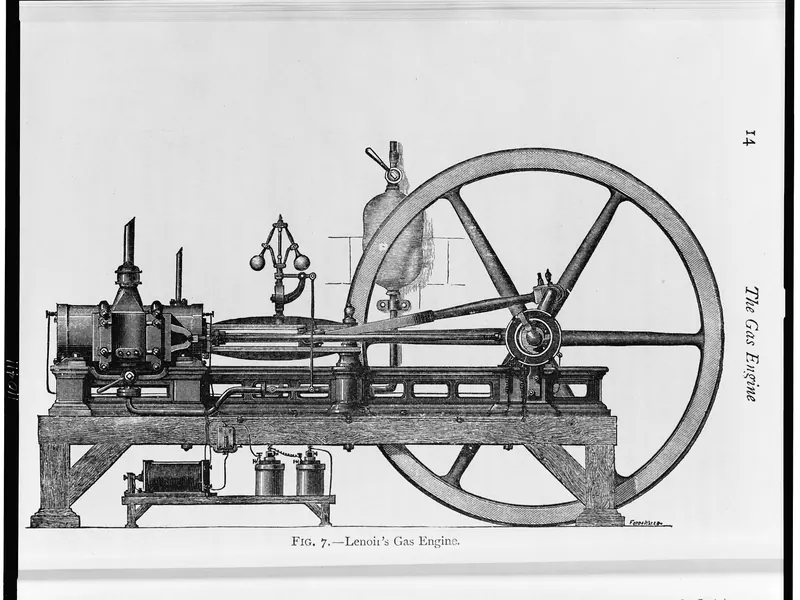
Lenoir’s 1860 engine used an early two-stroke cycle, a process still used in some mopeds and lawnmowers. Encyclopaedia Britannica: Étienne Lenoir
Many two-stroke machines are noisy and polluting, and some places have banned devices such as two-stroke leaf blowers. Encyclopaedia Britannica: Gasoline engine
Two pistons, one cylinder
An opposed-piston engine has two pistons moving in opposite directions in the same cylinder, with a crankshaft at each end joined by gears. Encyclopaedia Britannica: Gasoline engine
The Wankel rotary
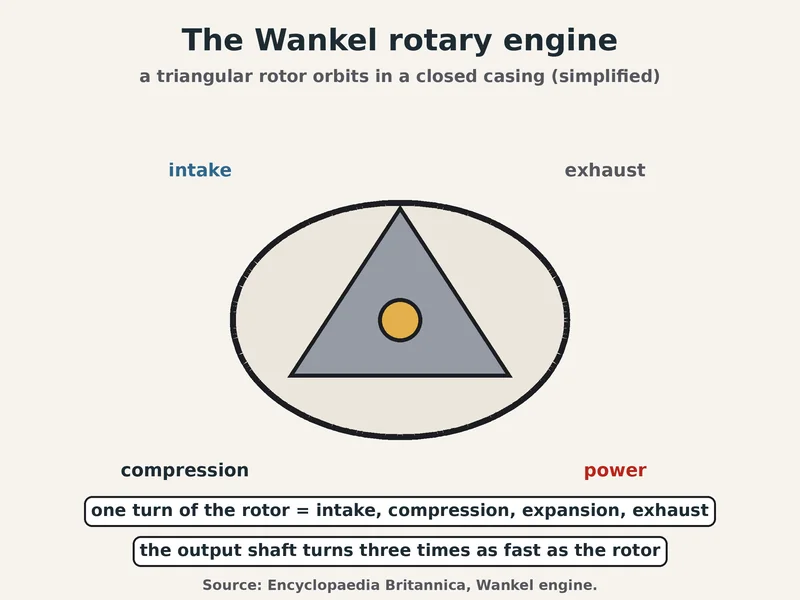
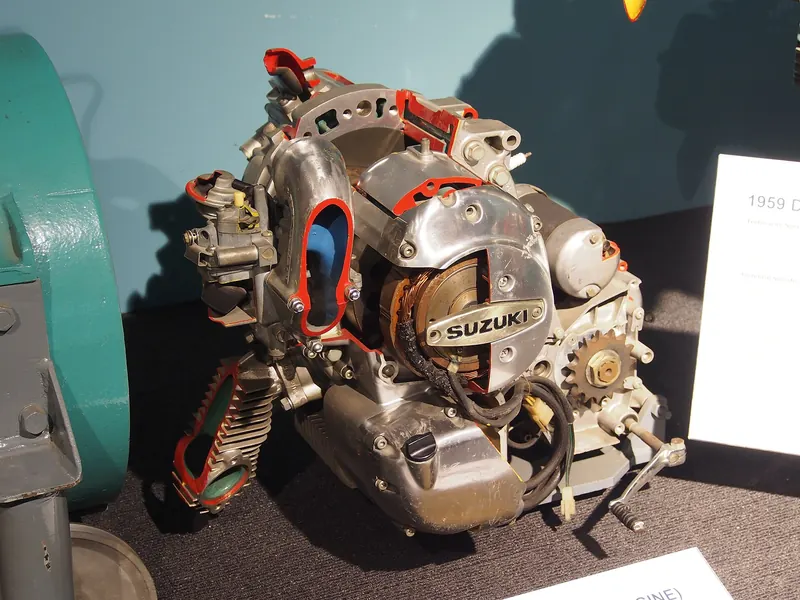
A Wankel rotary engine has no pistons going up and down: a curved triangular rotor orbits inside a closed casing. Encyclopaedia Britannica: Wankel engine
In a Wankel engine the output shaft turns three times as fast as the rotor, and one turn of the rotor completes intake, compression, expansion and exhaust. Encyclopaedia Britannica: Wankel engine The only moving parts of a Wankel engine are the rotor and the output shaft. Encyclopaedia Britannica: Wankel engine
Experimental Wankel engines were built and tested by a German firm from 1956. Encyclopaedia Britannica: Wankel engine
A Wankel engine is small and light for its power, smooth, quiet and cheap to make; fuel economy and the cost of meeting emission standards have limited its use, with Mazda the only maker to sell large numbers. Encyclopaedia Britannica: Gasoline engine A Wankel engine’s apex seals are oiled by adding a little oil to the fuel, as little as 1 part in 200. Encyclopaedia Britannica: Gasoline engine
Hybrids and electric cars
A hybrid car has a petrol or diesel engine and one or more electric motors; the battery is charged by regenerative braking and by the engine, not by plugging in. US Department of Energy, Alternative Fuels Data Center: How do hybrid electric cars work? The extra push from a hybrid’s electric motor can allow a smaller engine. US Department of Energy, Alternative Fuels Data Center: How do hybrid electric cars work?
An all-electric car has an electric motor instead of an internal-combustion engine, with no tailpipe exhaust and no fuel pump, fuel line or fuel tank. US Department of Energy, Alternative Fuels Data Center: How do all-electric cars work?
Hybrids, plug-in hybrids and electric cars use regenerative braking to win back some of the energy normally lost as heat in the brakes. US Department of Energy and EPA, fueleconomy.gov: Where the energy goes (petrol vehicles) Hybrid-style stop-start systems switch the engine off when the car stops and restart it when the accelerator is pressed. US Department of Energy and EPA, fueleconomy.gov: Where the energy goes (petrol vehicles)
And rockets
Rockets are internal-combustion engines too, and they are the one kind that does not take in air. Encyclopaedia Britannica: Internal-combustion engine
Next: myths vs facts →