Gears, torque and horsepower
How the engine’s turning force reaches the wheels, and how we measure power.
How gears work
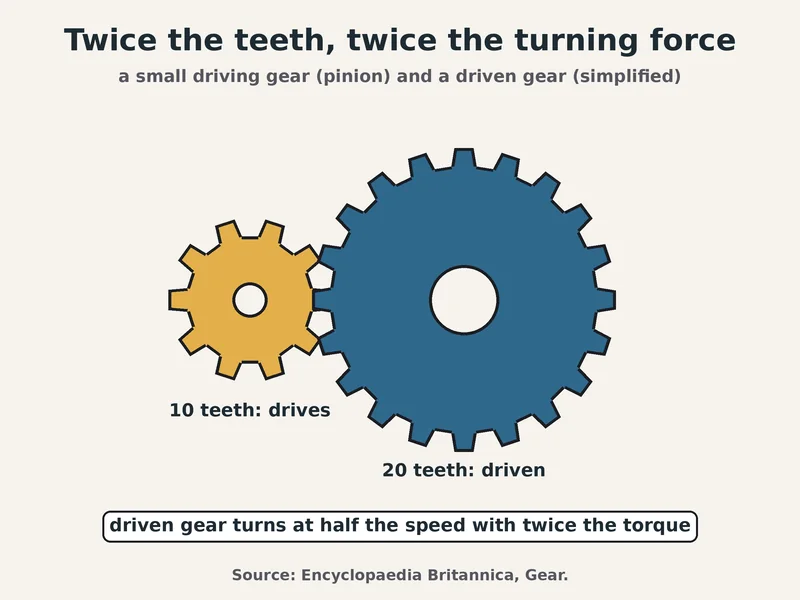
A gear is a toothed wheel on a shaft; gears work in pairs to pass on turning motion and torque (turning force) without slipping. Encyclopaedia Britannica: Gear
If the driven gear has twice as many teeth as the small driving gear, it turns at half the speed with twice the torque. Encyclopaedia Britannica: Gear
When the smaller gear of a pair drives, the pair slows the speed and multiplies the torque. Encyclopaedia Britannica: Gear Spur and helical gears join parallel shafts, bevel gears join shafts that meet, and a worm and gear is usually used for shafts that do neither. Encyclopaedia Britannica: Gear
A worm gear can have just one thread (tooth), but a spur or helical pinion needs at least five teeth. Encyclopaedia Britannica: Gear
The transmission
A car’s transmission passes the mechanical power from the engine to drive the wheels. US Department of Energy, Alternative Fuels Data Center: How do gasoline cars work?
The fully automatic transmission was introduced in 1939, and it changes gear by itself as the car speeds up and slows down. Encyclopaedia Britannica: Automatic transmission An automatic’s fluid coupling works like two fans facing each other: oil spun by one turbine turns the other. Encyclopaedia Britannica: Automatic transmission
An automatic transmission does its shifting with planetary gears and a speed-sensitive governor. Encyclopaedia Britannica: Automatic transmission
The differential
A differential lets the two driving wheels turn at different speeds round a corner while sharing the engine’s force equally between them. Encyclopaedia Britannica: Differential gear On a corner the outside wheel has farther to go, so it turns faster than the inside wheel. Encyclopaedia Britannica: Differential gear
The car differential was invented in 1827 by a Frenchman, Onésiphore Pecqueur, and was first used on steam vehicles. Encyclopaedia Britannica: Differential gear
Jack up both driving wheels in neutral, turn one, and the other turns the opposite way at the same speed. Encyclopaedia Britannica: Differential gear
If one wheel slips on ice or mud, an ordinary differential gives the other wheel less torque too; a limited-slip differential helps with this. Encyclopaedia Britannica: Differential gear
What is horsepower?
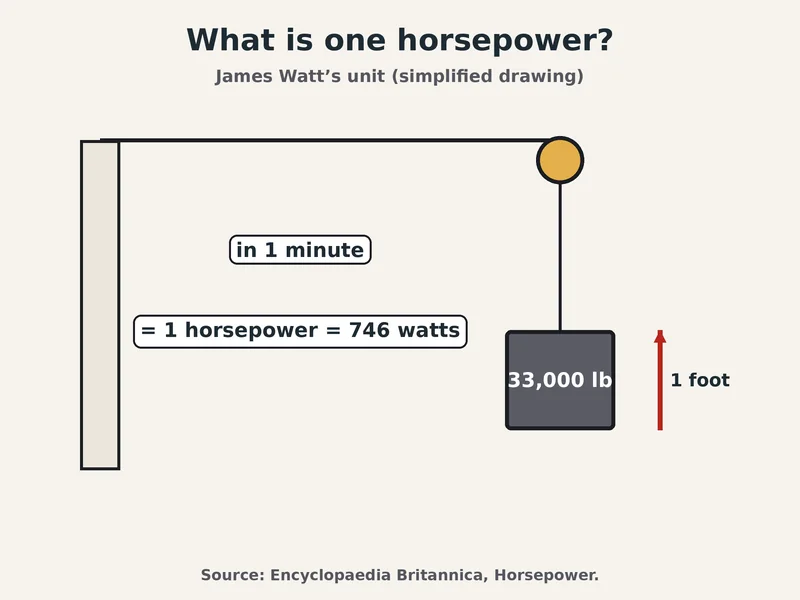
One horsepower is 33,000 foot-pounds of work a minute: enough to lift 33,000 pounds one foot in one minute. Encyclopaedia Britannica: Horsepower One horsepower is 746 watts. Encyclopaedia Britannica: Horsepower
James Watt chose the value of the horsepower in the late 18th century after tests with strong dray horses; it is about 50 percent more than an average horse can keep up all day. Encyclopaedia Britannica: Horsepower
A metric horsepower is a little smaller: 0.9863 of an imperial horsepower. Encyclopaedia Britannica: Horsepower Brake horsepower, measured at the output shaft, is less than indicated horsepower by the power lost to friction inside the engine, which can be 10 percent or more. Encyclopaedia Britannica: Horsepower
Losing energy on the way
Energy is also lost in the transmission and the rest of the driveline, and to brakes, wind resistance and the tyres’ rolling resistance. US Department of Energy and EPA, fueleconomy.gov: Where the energy goes (petrol vehicles)
Next: the pioneers →