Petrol and diesel engines
Both burn fuel inside a cylinder. The big difference is how the fuel is lit.
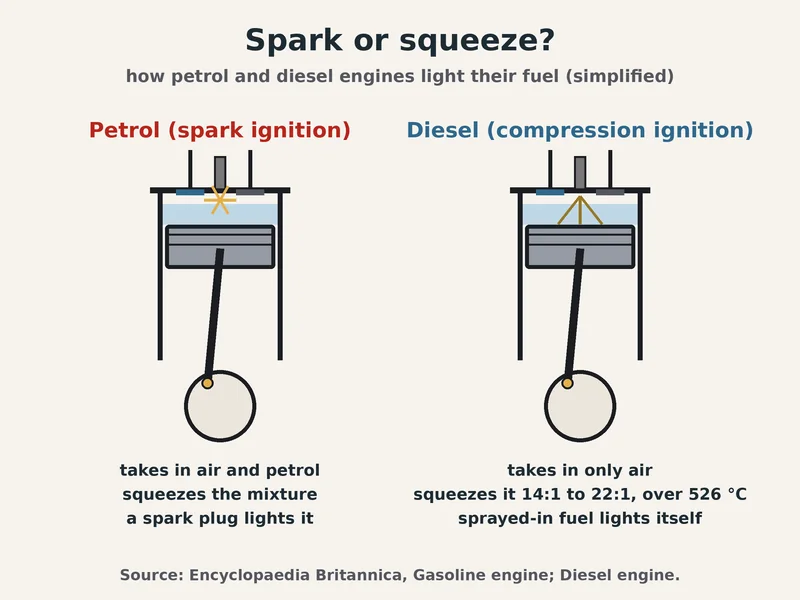
Petrol: lit by a spark
A petrol engine burns a volatile liquid fuel, petrol or a petrol mixture such as ethanol, and an electric spark starts the burning. Encyclopaedia Britannica: Gasoline engine In a spark-ignition engine the fuel is mixed with air in the combustion chamber, and a spark from the spark plug lights the mixture. US Department of Energy, Alternative Fuels Data Center: How do gasoline cars work?
Four-stroke petrol engines power the vast majority of cars, light vans, medium and large motorcycles and lawn mowers. Encyclopaedia Britannica: Gasoline engine Two-stroke petrol engines are less common, but they run small outboard boat motors and handheld garden tools such as chainsaws, hedge trimmers and leaf blowers. Encyclopaedia Britannica: Gasoline engine
Diesel: lit by squeezing
In a diesel engine, air is squeezed until it is hot enough to set alight the diesel fuel sprayed into the cylinder. Encyclopaedia Britannica: Diesel engine
Unlike a petrol engine, a diesel engine takes in only air on its intake stroke. Encyclopaedia Britannica: Diesel engine Diesel engines are also called compression-ignition engines, because the fuel is lit by air heated by squeezing, not by a spark. Encyclopaedia Britannica: Diesel engine
Diesel engines usually have compression ratios between 14:1 and 22:1. Encyclopaedia Britannica: Diesel engine The air in a diesel cylinder is usually hotter than 526 °C (979 °F), hot enough for the fuel to catch fire by itself. Encyclopaedia Britannica: Diesel engine
Diesel fuel is sprayed in at 7 to 70 megapascals (1,000 to 10,000 pounds per square inch) as the piston nears the top of its stroke. Encyclopaedia Britannica: Diesel engine Diesel engines are often turbocharged and aftercooled, which can improve both power and efficiency. Encyclopaedia Britannica: Diesel engine
Which is more efficient?
The diesel engine’s most outstanding feature is its efficiency: by squeezing air alone it can use higher compression ratios than a spark-ignition engine. Encyclopaedia Britannica: Diesel engine Diesel engines are generally about one-third more efficient than petrol engines. US Department of Energy and EPA, fueleconomy.gov: Where the energy goes (petrol vehicles)
A diesel does not throttle its intake to control power, so it is much more efficient than a petrol engine when idling or at low power. Encyclopaedia Britannica: Diesel engine
The main drawback of diesel engines is air pollution: they give off more soot, nitrogen compounds (NOx) and smell than spark-ignition engines. Encyclopaedia Britannica: Diesel engine
Small, medium and large diesels
Diesel engines power freight lorries, large tractors, locomotives and ships, as well as a limited number of cars. Encyclopaedia Britannica: Diesel engine
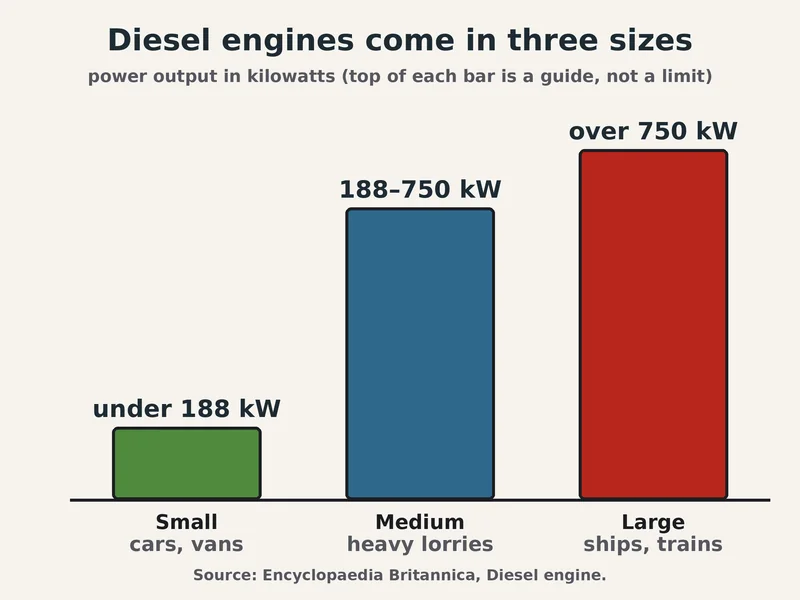
Small diesel engines make less than 188 kilowatts (252 horsepower) and are the most commonly made kind; they power cars, light vans and small generators. Encyclopaedia Britannica: Diesel engine Medium diesel engines, from 188 to 750 kilowatts, mostly power heavy lorries. Encyclopaedia Britannica: Diesel engine Large diesel engines, over 750 kilowatts, power ships and locomotives and generate electricity; some turn as slowly as 500 revolutions a minute. Encyclopaedia Britannica: Diesel engine
Diesel engines with cylinders wider than 600 mm (24 inches) are almost all two-strokes. Encyclopaedia Britannica: Diesel engine The simplest way to start a diesel is to blow high-pressure air into each cylinder in turn; others use an electric starter motor or even a small petrol engine. Encyclopaedia Britannica: Diesel engine
The fuels
Diesel fuel is made of heavier hydrocarbons, with at least 12 to 16 carbon atoms per molecule, that boil at 177 to 343 °C. Encyclopaedia Britannica: Diesel engine The cetane number describes how readily a diesel fuel ignites. Encyclopaedia Britannica: Diesel engine
A fuel’s octane number measures how well it resists knocking in an engine cylinder. Encyclopaedia Britannica: Octane number The octane number is the percentage of iso-octane, which resists knocking, in a blend with heptane, which knocks readily, that matches the fuel in a test engine. Encyclopaedia Britannica: Octane number
In the 21st century regular petrol in the United States was rated 87 octane and high-test about 93. Encyclopaedia Britannica: Automobile Ethanol is often blended with petrol (15 parts to 85) to raise its octane rating, but it holds less energy, so a tank goes less far. Encyclopaedia Britannica: Automobile
A little diesel history
Rudolf Diesel first planned to run his engine on powdered coal; after his experimental engine was destroyed by an explosion, he turned to liquid petroleum. Encyclopaedia Britannica: Diesel engine
The first commercial diesel engine in America was installed in St. Louis by the brewer Adolphus Busch, who had seen one at an exhibition in Munich. Encyclopaedia Britannica: Diesel engine
The diesel engine became the main power for submarines in the First World War, because it was economical and reliable and its fuel was less volatile than petrol. Encyclopaedia Britannica: Diesel engine
Play Spark or Squeeze? to test yourself.
Next: engine parts →